Mobile App Development Services in Chicago for Connected Business Growth
Chicago’s healthcare networks, financial institutions, manufacturers, logistics companies, retailers, universities, professional firms, and technology ventures need mobile products that simplify complex workflows, support secure data exchange, and remain dependable across customer-facing and operational environments.
OriginUX delivers Mobile App Development Services in Chicago by combining business analysis, product planning, UI/UX design, native and cross-platform engineering, API integration, cloud architecture, quality assurance, deployment, and long-term optimization around measurable business outcomes. Build a practical mobile product that supports adoption, efficiency, and future growth.
0%
Faster App Launch Planning
0%
Better User Experience Clarity
0x
Stronger Product Scalability Potential
Our Approach
Our Proven Path to Mobile App Development Excellence
A dependable Mobile App Development Company in Chicago begins by studying user needs, operational systems, regulatory expectations, technical dependencies, and commercial goals before recommending features, platforms, or architecture.
Our delivery model connects discovery, product strategy, experience design, development, testing, deployment, analytics, and maintenance through one accountable roadmap that helps stakeholders make informed decisions.
This approach keeps usability, security, maintainability, and measurable product value visible throughout every stage of delivery.
Turn Mobile App Ideas into Practical Digital Products
Start with the business problem before defining the feature list.
A capable Mobile App Development Agency in Chicago converts an early concept into a validated release plan, while an experienced Mobile App Development Company in Chicago helps prioritize essential functions, test critical workflows, select suitable technology, and define clear success measures before investment expands. Move from assumptions to a focused product roadmap supported by evidence.
Our Core Mobile App Development Services in Chicago
Our mobile app development services are designed to create fast, scalable, and user-friendly applications tailored to your business goals. From strategy and design to development and support, we deliver solutions that drive engagement and growth.
iOS App Development
Native iOS applications are built around Apple interaction standards, accessibility, secure data handling, performance, device capabilities, and App Store submission requirements.
Android App Development
Android applications are planned for varied devices, screen sizes, operating conditions, performance expectations, and Google Play release requirements while maintaining a consistent experience.
Cross-Platform App Development
Flutter and React Native support coordinated iOS and Android delivery when shared development, rapid iteration, and consistent functionality align with the product roadmap.
Custom Mobile Applications
Custom mobile applications address specialized workflows such as customer portals, field tools, booking systems, inspections, approvals, ordering, memberships, and business automation.
Enterprise Mobile App Development
Enterprise mobile apps connect internal systems, role-based access, legacy platforms, operational data, governance policies, and distributed processes for employees, partners, and customers.
App Maintenance and Performance Optimization
Ongoing support covers operating-system updates, defect resolution, performance monitoring, dependency management, analytics reviews, feature refinement, release planning, and App Store Optimization.
Step-by-Step Approach for Lasting Mobile App Success
Discovery and Requirement Analysis
We clarify business goals, target users, workflows, integrations, security needs, technical constraints, dependencies, data rules, and measurable outcomes before detailed planning begins.
Product Strategy and Roadmap Planning
The roadmap defines product scope, platform direction, architecture, feature priorities, analytics, release phases, responsibilities, risks, and the capabilities that should be deferred until evidence supports further investment.
UI/UX Design, Wireframing, and Prototyping
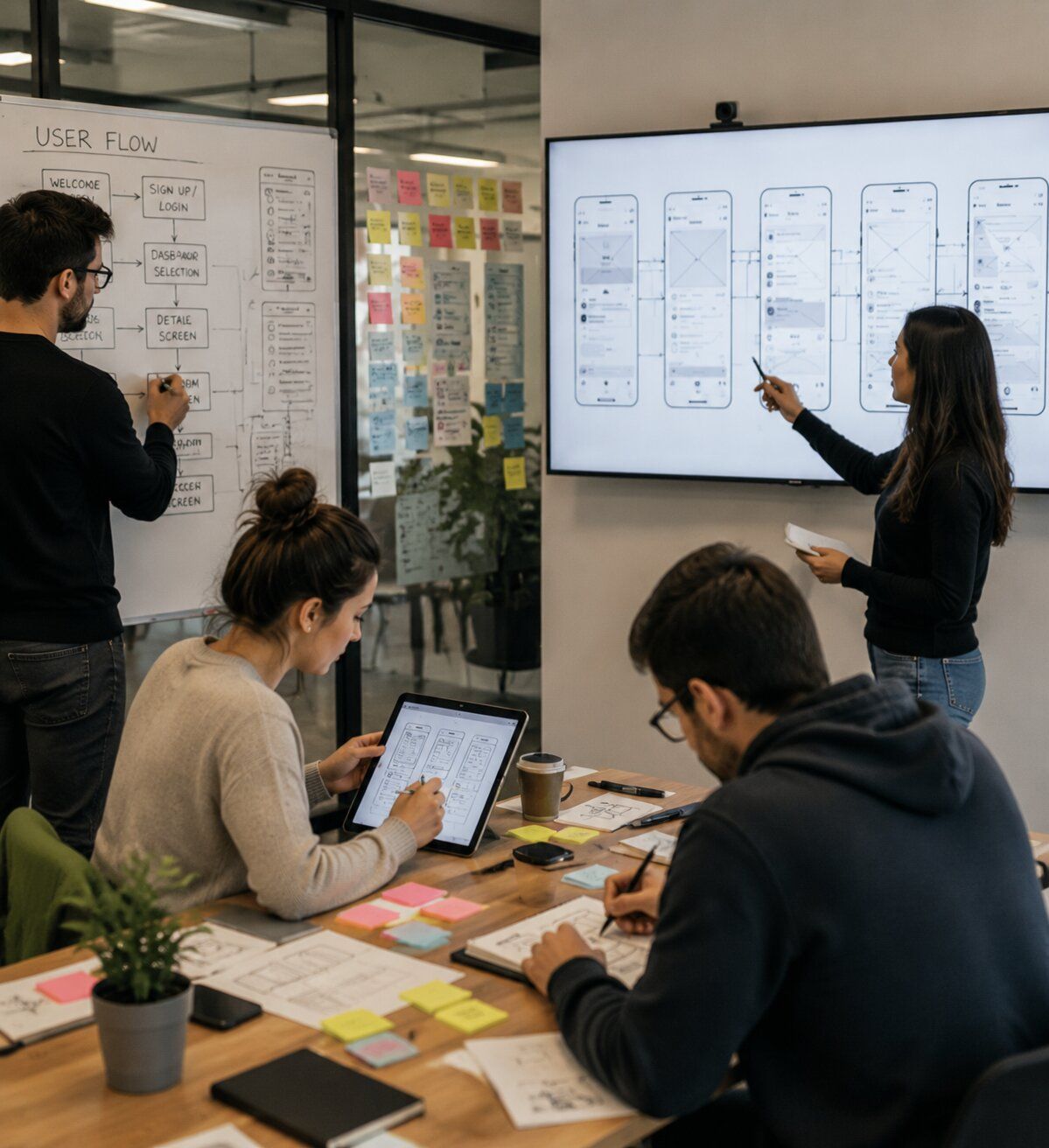
Designers create information architecture, user flows, wireframes, interface systems, and interactive prototypes, then test navigation, accessibility, content, and task completion before engineering starts.
Application Development and Quality Assurance
An experienced Mobile App Development Company in Chicago builds interfaces, APIs, databases, administration tools, and integrations through agile sprints, while quality assurance validates functionality, compatibility, performance, usability, accessibility, security, edge cases, and regression risks.
Deployment, App Store Launch, and Optimization
A skilled Mobile App Development Agency in Chicago prepares production environments, monitoring, analytics, backups, store assets, privacy details, and release builds, then uses performance data and customer feedback to guide maintenance, ASO, security updates, and continuous improvement.
Business Discovery and Experience Architecture
Product discovery prevents teams from building a polished solution to the wrong problem. Workshops examine user needs, commercial goals, existing workflows, competitor alternatives, technical constraints, compliance expectations, and operational risks. The outputs can include user groups, problem statements, prioritized requirements, feature scope, journey maps, wireframes, interactive prototypes, and measurable success criteria.
Strong mobile products begin with a clear understanding of the work users need to complete, so businesses using Mobile App Development Services in Chicago receive research, journey mapping, requirement prioritization, wireframes, prototypes, integration planning, and measurable success criteria before major engineering investment begins.
Native and Cross-Platform App Development
Technology selection should follow product requirements rather than current trends. Native iOS or Android development may suit applications requiring advanced performance, complex device capabilities, or platform-specific experiences. Flutter or React Native may be appropriate when coordinated delivery and shared functionality are priorities.
Native iOS or Android development can support products requiring advanced performance, deep device access, or platform-specific interaction, while Flutter and React Native can improve coordinated delivery when shared functionality, faster iteration, and maintainable cross-platform releases are priorities.
API, Cloud, Security, and System Integration
Mobile applications can connect with payment services, CRM platforms, ERP systems, identity providers, warehouse tools, maps, analytics, IoT devices, and proprietary databases through secure APIs, scalable cloud infrastructure, resilient data flows, monitoring, encryption, and controlled access.
Cloud architecture may include scalable infrastructure, managed databases, secure storage, automated deployment, backups, and content delivery. Security planning covers authorization, encryption, API protection, secure storage, input validation, secrets management, and dependency risk so the mobile product can operate safely within the wider business ecosystem.
Testing, Launch, Maintenance, and Optimization
Quality assurance validates critical workflows, accessibility, device compatibility, performance, interrupted connections, security, and regression risks, while post-launch analytics, crash reports, reviews, platform updates, and feature-adoption data guide ongoing product improvement.
After launch, the product is improved through crash reports, analytics, user interviews, support feedback, store reviews, security patches, platform updates, ASO, and feature adoption data. This evidence-led cycle helps the application remain stable, relevant, and commercially useful.
Tailored Architecture for Every Industry

Ecommerce
We build ecommerce apps that support product discovery, secure checkout, cart recovery, order updates, wishlists, offers, and customer retention.

Healthcare
We create apps for appointment booking, patient communication, reminders, consultation access, report sharing, and healthcare service management.

Education
We craft scalable cloud architecture, keeping online stores resilient and ready for peak traffic surges.

Real Estate
We build apps for property discovery, project listings, filters, virtual tours, enquiries, saved searches, and site visit scheduling.

Finance
We support secure mobile experiences for dashboards, account access, alerts, calculators, document access, and customer communication.

Technology
We help technology companies extend SaaS products, workflow tools, internal platforms, and customer portals to mobile users.
Clients who trust us








































Why Us? The OriginUX Advantage
OriginUX manages mobile product delivery as a coordinated business and technology program that brings research, strategy, UI/UX design, engineering, quality assurance, integration, deployment, and optimization into one transparent roadmap.
Choosing the right partner requires reviewing product thinking, engineering depth, security practices, documentation, communication, testing methods, and post-launch support rather than relying on a broad technology list.
A dependable Mobile App Development Agency in Chicago recommends native, cross-platform, AI-powered, cloud-based, or IoT-connected solutions only when they support genuine user, operational, and commercial requirements.
What You Achieve Through Our Mobile App Development
Higher User Adoption
Apps built around real user journeys are easier to understand, which improves first-time usage and repeat engagement.
Better Customer Convenience
Users can book, buy, learn, track, communicate, or access services directly from their mobile device.
Improved Conversion Paths
Clear forms, smooth checkout, fast booking, and simple navigation help users complete important actions faster.
Our Mobile App Development Toolkit

Figma
For wireframes, prototypes, interface design, and design systems.

Flutter
For efficient cross-platform app development across Android and iOS.

Firebase
For authentication, analytics, cloud messaging, and crash reporting.

React Native
For scalable mobile apps with reusable components.
FAQS

OriginUX studio is based out of Bangalore, India.
We are a cross-disciplinary design team that loves to create great experiences and make meaningful connections for businesses and their users through UI & UX.
Industries we serve