AI Development Services in Austin for Products That Scale
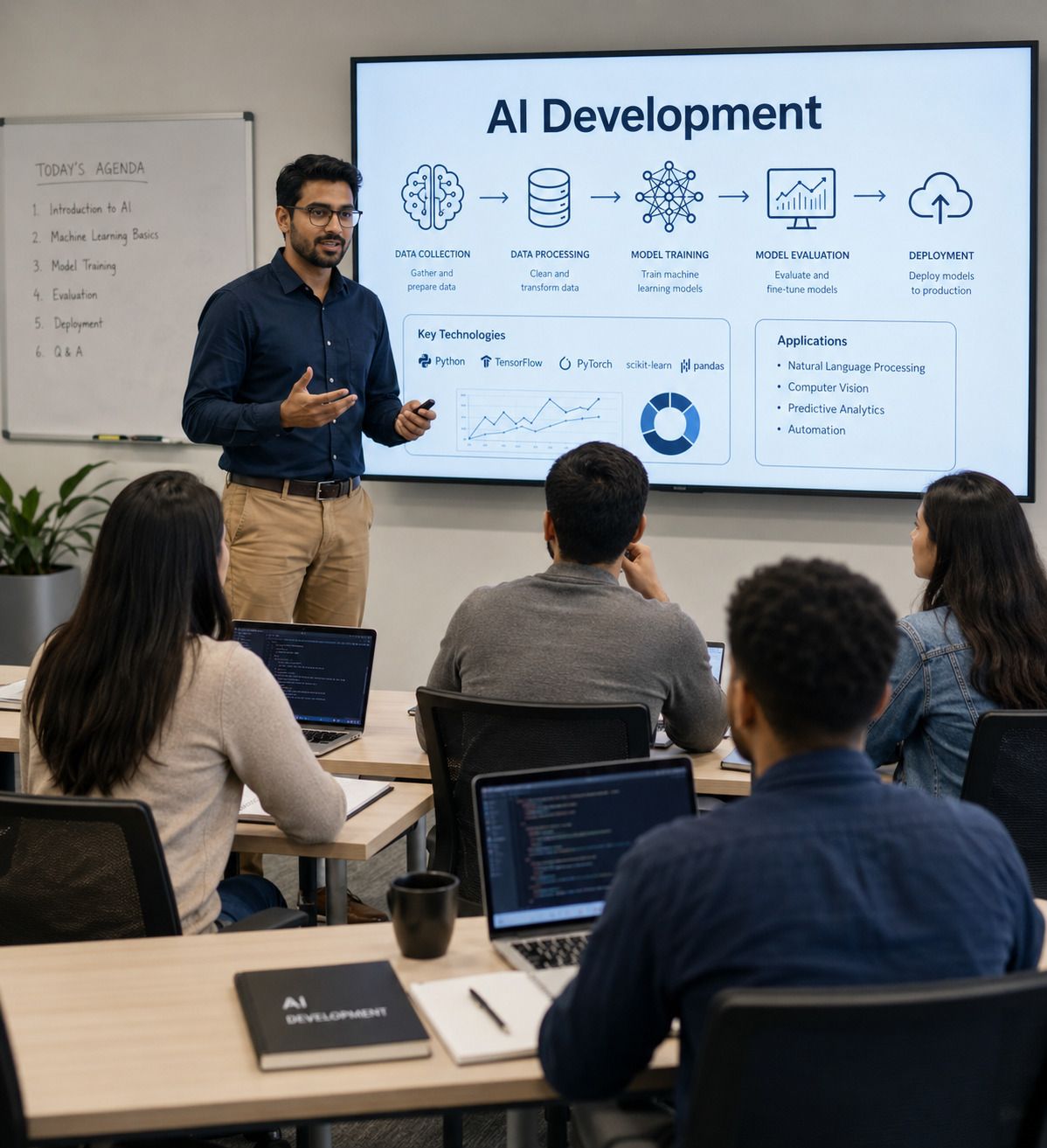
Austin businesses thrive on rapid experimentation, technical talent, and bold product thinking. Origin UX provides AI development services in Austin for companies ready to turn complex ideas into dependable digital solutions. We build intelligent platforms, predictive models, AI copilots, automation systems, and computer vision tools shaped around real user needs. Our team examines business goals, data readiness, existing technology, and operational constraints before development begins. From early validation to launch, every stage stays focused, collaborative, and transparent. The outcome is practical AI that helps teams innovate faster, improve daily performance, and create products with lasting commercial value across competitive markets.
0+
AI Use Cases Assessed
0X
Faster Product Experimentation
0%
Shorter Support Resolution
Our Approach
Our Approach as an AI Development Company in Austin
As an AI development company in Austin, Origin UX combines product strategy, user experience, and engineering from the first discussion. We study the workflow, audience, data, and technical environment before selecting models or platforms. This keeps the project focused on useful outcomes instead of unnecessary features. Our team validates concepts early, communicates trade-offs clearly, and plans for integration, security, cost, and scale. The result is an AI solution that fits current operations, supports real users, and remains adaptable as the business grows over time confidently.
Core Services from an AI Development Company in Austin
Focused AI services help Austin businesses build stronger products, automate work, and scale technical capabilities.
AI Copilot Development
Create context-aware copilots that guide users, retrieve knowledge, and support approved tasks across digital products.
Predictive Model Engineering
Develop forecasting and scoring models for demand, risk, maintenance, user behavior, capacity, and operational planning.
Computer Vision Applications
Build image-analysis systems for inspection, recognition, monitoring, quality control, asset tracking, and visual data interpretation.
Intelligent Workflow Automation
Automate multi-step processes involving documents, decisions, data movement, approvals, notifications, and exception handling across teams.
AI Platform Integration
Connect models with cloud products, databases, APIs, business software, connected devices, and analytics environments securely.
Our AI Development Process, Step by Step
Opportunity Mapping
We define the business problem, intended users, available information, and expected outcome so the project begins with a valuable, realistic, clearly shared, and measurable direction.
Data and Architecture Review
Our team evaluates data quality, system dependencies, privacy needs, infrastructure, and model options before recommending the strongest technical foundation, delivery sequence, and practical implementation priorities.
Prototype Validation
We create a focused prototype that lets stakeholders test the core workflow, review output quality, gather feedback, compare options, and confirm product value before wider development.
Engineering and Assurance
Models, interfaces, APIs, and data pipelines are developed together, then tested for reliability, accuracy, security, speed, usability, integration quality, and behavior under realistic operating conditions.
Launch and Iteration
After deployment, we monitor adoption, model performance, user feedback, infrastructure usage, and failure patterns, using those insights to guide practical improvements, optimization, and future releases.
AI Product Blueprint
Receive a structured blueprint covering target users, priority use cases, required data, technical architecture, delivery phases, risks, ownership, and measurable outcomes before larger development decisions are made with greater confidence.
Experience-Led Prototyping
Test how people understand, trust, and use the AI through purposeful interfaces, guided interactions, review points, and early prototypes built around realistic scenarios, everyday tasks, and clear user expectations early.
Scalable Technical Delivery
Launch with maintainable code, secure APIs, monitored infrastructure, documented integrations, and reusable services that support larger workloads, additional features, internal ownership, efficient maintenance, and future platform expansion without major disruption.
Adoption and Optimization
Support users with documentation, training, performance monitoring, issue resolution, and planned improvements that keep the AI aligned with changing workflows, models, policies, business priorities, adoption needs, ownership, responsibilities, and expectations.
AI Solutions for Different Business Types

Technology and SaaS
Build AI-powered features, copilots, intelligent search, automation, and predictive tools that improve software products while protecting usability, reliability, security, and performance.

Semiconductor and Electronics
Use AI for defect detection, equipment monitoring, design analysis, diagnostics, and production optimisation across semiconductor, electronics, and connected-device environments.
Manufacturing and Engineering
Apply AI to quality inspection, predictive maintenance, process optimisation, asset monitoring, and technical decision support across complex industrial operations

Retail and E-commerce
Improve product discovery, personalised recommendations, customer support, merchandising, demand planning, and inventory decisions across digital and physical commerce channels.

Financial Services
Modernise fraud monitoring, onboarding, document review, customer service, risk analysis, and reporting through secure, governed AI systems.

Healthcare
Support administrative workflows, patient communication, knowledge access, diagnostics assistance, and operational planning while maintaining privacy, professional oversight, and responsible data use.
Clients who trust us










































Why Austin Businesses Choose Origin UX
Origin UX combines product thinking, experience design, AI engineering, and software integration within one collaborative team. We help Austin businesses choose valuable problems, test assumptions early, and avoid unnecessary technical complexity. Every engagement considers users, data, security, operating cost, adoption, and future ownership. Clear communication keeps stakeholders involved, while practical engineering creates AI solutions that can perform reliably and evolve with changing business needs.
Building Lasting Value Through Applied AI
Quicker Product Validation
Test the most important AI workflow before expanding scope, helping teams learn from real users, technical evidence, and market feedback with less wasted investment overall.
Smarter Technical Decisions
Compare model quality, speed, cost, privacy, and integration requirements through structured evaluation, giving product leaders stronger evidence for architecture, platform, deployment, investment, and roadmap choices.
More Productive Teams
Reduce repetitive searching, classification, reporting, and coordination so employees can spend more time solving complex problems, supporting customers, and creating meaningful business value each day.
Better Connected Systems
Integrate AI with current products, databases, cloud platforms, and workflows so useful intelligence appears where people already complete their work, collaborate, and make decisions daily.
Stronger Foundations for Scale
Use reusable services, documented integrations, monitoring, and cost-aware architecture to support new features, larger audiences, changing model options, and sustained product growth with greater confidence.
Tools and AI Technologies We Use

Python and PyTorch
Support model development, experimentation, data processing, evaluation, and production deployment across custom AI product requirements.

OpenAI
Power selected conversational, reasoning, extraction, and knowledge workflows when generative capabilities match the project’s goals.

AWS and Google Cloud
Provide scalable infrastructure for data pipelines, model hosting, application deployment, monitoring, security, and controlled growth
Pinecone and LangChain
Enable retrieval, orchestration, and context-aware AI workflows using approved documents, databases, tools, and business knowledge.
FAQ's

OriginUX studio is based out of Bangalore, India.
We are a cross-disciplinary design team that loves to create great experiences and make meaningful connections for businesses and their users through UI & UX.
Industries we serve