- Who We Help
-
Capabilities
Product DesignProduct DevelopmentAIGrowth & SupportProduct DesignProduct DevelopmentSoftware DevelopmentWeb Application Development (SaaS, PWA, Portals)Full Stack DevelopmentEnterprise Software DevelopmentDatabase Architecture & EngineeringWeb Development ServicesCMS DevelopmentSoftware Architecture & WireframingMobile App DevelopmentSoftware DevelopmentWeb Application Development (SaaS, PWA, Portals)Full Stack DevelopmentEnterprise Software DevelopmentDatabase Architecture & EngineeringWeb Development ServicesCMS DevelopmentSoftware Architecture & WireframingAIGrowth & SupportSoftware & App Maintenance Website Maintenance Performance Optimization (Speed, UX, Code) App Store Optimization (ASO) Feature Iteration & Versioning Conversion Rate Optimization (CRO) Analytics Setup & Reporting CRM & 3rd Party Tool Integration Tech Support & SLA-based Services Security Audits & Compliance
- Solutions
- Industries
- Design-Ops
- Technologies
- Company


Why Design Thinking Matters: Importance of Design Thinking in Modern Business
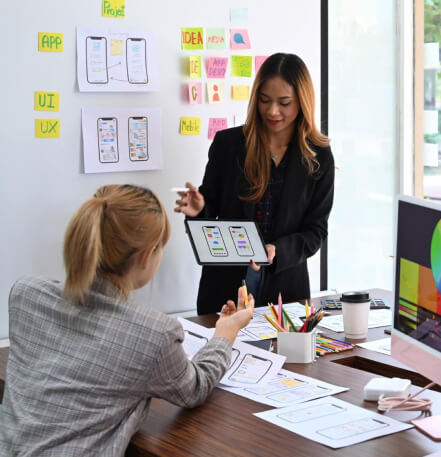
Design thinking holds significant importance in modern business as it places a paramount emphasis on understanding and meeting the needs of customers. By adopting a customer-centric approach, businesses can develop products and services that resonate deeply with their target audience, fostering stronger relationships and loyalty.
Brands that trust us





































Moreover, design thinking cultivates a culture of innovation and creativity by encouraging iterative problem-solving processes. Through prototyping, testing, and refining solutions based on feedback, businesses can swiftly adapt to evolving market demands and mitigate risks associated with product development.
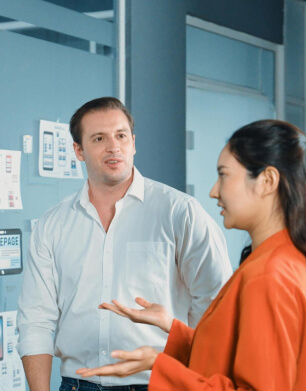
Furthermore, design thinking promotes cross-functional collaboration, drawing on diverse perspectives and skill sets to drive innovation and problem-solving. By bringing together employees from various departments, businesses can leverage a wealth of insights and expertise, enhancing the quality and relevance of their offerings.
This collaborative approach, combined with a mindset of adaptability and flexibility, enables businesses to respond effectively to changing market dynamics and gain a competitive edge. Ultimately, embracing design thinking empowers businesses to create meaningful customer experiences, foster innovation, and position themselves for sustained success in today's dynamic business landscape.
Benefits for organizations
Enhanced Customer Satisfaction
Design thinking helps organizations better understand and address the needs of their customers, leading to products and services that align more closely with customer preferences - resulting in customer satisfaction.
Increased Innovation and Creativity
By fostering a culture of innovation and creativity, design thinking encourages organizations to explore new ideas and solutions, driving continuous improvement and differentiation in the marketplace.
Improved Problem-Solving
Design thinking promotes a structured and iterative approach to problem-solving, enabling organizations to identify and address challenges more effectively through prototyping, testing, and iteration.
Reduced Time to Market
The iterative nature of design thinking allows organizations to quickly develop and refine prototypes, reducing the time it takes to bring products and services to market and enabling faster responses to changing customer needs and market trends.
Enhanced Collaboration and Communication
Design thinking encourages cross-functional collaboration and communication, dissolving silos within organizations and fostering a shared understanding of customer needs and business objectives.
Risk Mitigation
By involving customers early in the design process and continuously testing and refining solutions, design thinking helps organizations mitigate the risk of developing products or services that fail to meet customer expectations or market demands.
Increased Competitive Advantage
Organizations that embrace design thinking are better positioned to differentiate themselves from competitors by delivering innovative products and services that provide unique value to customers, ultimately strengthening their competitive advantage in the marketplace.
Our Approach to Design Thinking
Philosophy
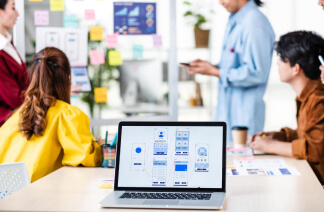
To make a profound difference in the quality of every person’s experience with a brand. Our numero uno aim is to ensure business owners offer a great customer experience, every single time.
Methodology
We encourage organizations to embrace a design-driven culture that puts customers first. By doing so, brands can leverage a distinct competitive advantage.
The design thinking process is a great way for companies to identify their customers' unmet needs and future opportunities. This will help them produce an integrated ecosystem offering that delights customers, staves off threats from competitors on the market place as well creates new sources of value with what they offer.
Our Four Pillars of Design Thinking

Interact with business stakeholders, technologists, marketers, product and service evangelists, and introduce new possibilities and potential initiatives and solutions to existing roadblocks.
Collaborate with expert facilitators to apply agile concepts in workshops. Topics include rapid prototyping, customer journeys and business KPIs while also touching on technology possibilities or marketing narratives.
Understand your customers’ and users’ points of view and behavior. Develop conversations with key innovators, and get exposure to their perspective and foster fresh ways of thinking.
Design and scale new digital experiences through collaborative workshops, envision how they could be integrated into your business. Essentially, we leverage our expertise, ideas and findings to reimagine user experiences.
Our Process
Design thinking is a powerful tool for businesses large and small. It can have an impact on customer satisfaction, revenue growth rates as well cost-to-serve departments while also positively impacting employee engagement levels in the process.
Design thinking helps us understand our customers and users at every step in their decision journey. It also creates a map for meeting an organization’s underlying requirements by empathizing with them, exploring possibilities through:

Definition
What do your customers care about? And how can you identify their needs to make sure they get the most out of their experience with you.

Research
Apply research and psychology. And that means digital technologies as well to create new, memorable experiences.

Experiment
Prototyping is the backbone of any successful product. Test your ideas with end users and get feedback for a sense for how your idea will feel in reality.

Design and Scale
Create outcomes for all stakeholders of your organization. Design thinking helps with achieving company goals towards shared ambitions.
Services Offered
Comprehensive list of consulting services
At OriginUX Studio, we design experiences that matter. We spot opportunities, focus on unmet needs of customers, re-imagine products and transform organizations to be design-first. Our team of analysts, researchers, developers, and designers work alongside your team to understand its capabilities and values, uncover customer and user insights, and craft exceptional customer experiences through product, service, and customer experience design.
Product Design
We specialize in imagining customer experiences for SaaS Products.
We start by learning where you are and where you want to get to. Based on the lifecycle
and
maturity of the product or idea, we start by exploring your requirements and unmet needs
of
your consumer.
Through design thinking workshops, scope discovery and rapid prototyping, our design teams align all stakeholders, commercial use cases, customer experiences and even devops and to fully support your product launch.
Service Design
We craft service design and strategy and take accountability to meet business
outcomes.
Through improvised design experience, we will help you drive strategic priorities within
your organizations. Companies today seek design intervention at all stages of
interaction to
empower people at all levels.
By empathizing with employees and customers at every step in their journey, we re-imagine an experience that meets their needs and delivers a unified business outcome. Through design practices, our UX modernisations move the needle of impact from customer satisfaction to revenue growth to operational excellence and employee engagement.
Customer Experience Design
Infuse your organization with a Customer- Delight culture that puts the users at the core and provide your brand with real, measurable results along with a competitive advantage.
Good design is good business. Gone are the days of siloed design and experiences.
Customer experiences are now connected more than ever and are more integrated with business strategy, marketing strategy, marketing execution, operations, and product design.
Reinvent your business from the core. We bring experience strategy, data and analytics, interaction design, and implementation expertise for you to ace customer delight.
Consulting Process
Through a detailed consulting process we ensure that we walk the entire journey with you - from understanding and analyzing the problem to evaluation and iterating product development so we have an output that meets the needs and desires of our customers.
Throughout this process, we emphasize collaboration, creativity, and a human-centered approach to problem-solving.

Understanding the Problem
Here, we understand the problem or challenge that the client organization is facing by conducting interviews, observations, and research to gain insights into the needs, pain points, and goals of the organization and its stakeholders.

Empathy and User Research
Design thinking emphasizes empathy with end-users, so the next stage involves conducting user research to understand the perspectives, behaviors, and preferences of the people who will interact with the product or service being developed.

Defining the Problem
Based on the insights gathered from user research and stakeholder interviews, the problem or challenge is defined in a way that is actionable and meaningful. Here, we synthesize the information collected and identify the core issues that need to be addressed.

Ideation and Brainstorming
In this stage, cross-functional teams come together to generate a wide range of ideas and potential solutions to address the defined problem. Ideation sessions may involve brainstorming, sketching, prototyping, and other creative techniques.

Prototyping and Testing
Once ideas have been generated, they are translated into tangible prototypes or mock-ups that can be tested with end-users. This stage involves rapid prototyping and iterative testing to gather feedback, refine solutions, and identify areas for improvement.

Iteration and Refinement
Based on the feedback received during testing, solutions are iterated upon and refined to address user needs and preferences more effectively. This iterative process continues until a viable solution is developed that meets the requirements of the client organization and its stakeholders.

Implementation and Deployment
The final stage involves implementing the solution and deploying it within the client organization or to end-users. This may involve developing implementation plans, providing training and support, and monitoring the solution's performance to ensure its success.

Evaluation and Iteration
After the solution has been implemented, it's important to evaluate its effectiveness and impact. This may involve collecting data, soliciting feedback, and conducting post-implementation reviews to identify lessons learned and areas for further improvement.
Discovery and Design Thinking Workshop
Our comprehensive branding workshop encompasses a meticulous approach to crafting a distinctive brand identity that resonates deeply with your target audience and stands out in the competitive marketplace. Through a series of strategically designed phases, we:

Engage in Stakeholder Interviews and Target Audience Analysis

Conduct Secondary Market Analysis

Host Brainstorming Sessions with Cross-functional Teams

Develop Conceptual Directions

Finalize and Document the Brand Identity

Conclude with a Workshop Closure
FAQs

OriginUX studio is based out of Bangalore, India.
We are a cross-disciplinary design team that loves to create great experiences and make meaningful connections for businesses and their users through UI & UX.
Industries we serve