- Who We Help
-
Capabilities
Product DesignProduct DevelopmentAIGrowth & SupportProduct DesignProduct DevelopmentSoftware DevelopmentWeb Application Development (SaaS, PWA, Portals)Full Stack DevelopmentEnterprise Software DevelopmentDatabase Architecture & EngineeringWeb Development ServicesCMS DevelopmentSoftware Architecture & WireframingMobile App DevelopmentSoftware DevelopmentWeb Application Development (SaaS, PWA, Portals)Full Stack DevelopmentEnterprise Software DevelopmentDatabase Architecture & EngineeringWeb Development ServicesCMS DevelopmentSoftware Architecture & WireframingAIGrowth & SupportSoftware & App Maintenance Website Maintenance Performance Optimization (Speed, UX, Code) App Store Optimization (ASO) Feature Iteration & Versioning Conversion Rate Optimization (CRO) Analytics Setup & Reporting CRM & 3rd Party Tool Integration Tech Support & SLA-based Services Security Audits & Compliance
- Solutions
- Industries
- Design-Ops
- Technologies
- Company


Navigating the Path to Insights: A Guide for Problem Solvers
February 20, 2024 | Read Time : 3 mins
Table of Contents
Unlocking insights is a crucial skill for design researchers, consultants, and problem solvers across various disciplines. Yet, achieving a consistent ability to generate insights can seem daunting, especially for those early in their careers.
This guide demystifies the process, presenting a structured approach that views insight generation not as a sporadic act of magic but as a skill that can be developed and refined.
By envisioning problem-solving in spatial dimensions, we can uncover a more reliable pathway to insights, empowering practitioners to approach challenges with confidence and creativity.
Introduction
The journey to generating reliable insights is often perceived as elusive, a process shrouded in uncertainty. This guide aims to transform that perception by offering a clear roadmap to insights, highlighting that great businesses and solutions are designed through systematic and insightful thinking.
Understanding Insights
Definition and Importance
An insight is a sudden realization that reshapes our understanding of a problem, offering new perspectives that were previously unnoticed. It’s the “aha!” moment that extends our knowledge or challenges conventional wisdom, forming the backbone of value creation in consulting and problem-solving professions.
The Problem-Solving Cube
Core Elements of Problem-Solving
Envisioning the problem as a cube allows us to dissect it into manageable components: frameworks, models, variables, and data, each playing a distinct role in the journey towards solution development. This spatial representation aids in visualizing the iterative loop of applying and adjusting frameworks based on new data, a critical process in developing actionable insights.

The Three Steps to Insight
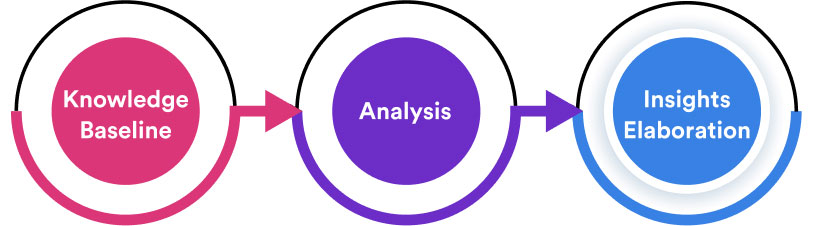
Preparatory Step: Understanding the Knowledge Baseline
The initial step involves a thorough analysis of the existing knowledge, assumptions, and biases. Understanding the client’s perspective, their knowns and unknowns, and the conventional wisdom in the project’s domain lays the groundwork for innovative thinking.
Step 2: Analysis
- Diving into the Data: Exploring and interrogating the data closely can reveal new information or highlight overlooked details, guiding the problem solver in identifying areas of interest or concern.
- Using Different Frameworks: Applying various frameworks to the same data set enables a shift in perspective, potentially uncovering novel insights by reframing the problem or identifying unexplored solutions.
- Finding Similarities with Different Domains: Drawing parallels from different sectors or industries can inspire innovative approaches, pushing the boundaries of traditional thinking to find unique solutions.
Step 3: Insights Elaboration
Transforming analysis into insights requires identifying findings that are non-obvious, generalizable, and actionable. The elaboration of insights involves not just recognizing these moments but understanding their implications and how they can drive project outcomes.
Mastering the Art of Insight Generation
Cultivating the ability to generate insights is achievable through dedicated practice and a methodical strategy. By rigorously examining the foundational knowledge, applying a variety of analytical methods, and honing the skill to identify significant discoveries, problem solvers can significantly boost their potential for innovative thinking and creating value.
The path to generating insights is a structured journey that can be navigated with the right tools and mindset. By breaking down the problem-solving process into spatial dimensions and following a systematic approach to analysis and interpretation, practitioners can develop the skill to uncover valuable insights consistently, driving meaningful solutions and business success.

AUTHOR
Team OriginUX
OriginUX Studio is a CoE for User Experience providing UI & UX across Product, Service and Customer Experience Design. We are a cross-disciplinary design team that loves to create great experiences and make meaningful connections for businesses and their users through UI & UX.
Founded in 2016, our larger purpose is to help brands understand what they want to do and where they want to go. To do that we have to make understanding customer experience simple, effortless, and affordable for everyone.